
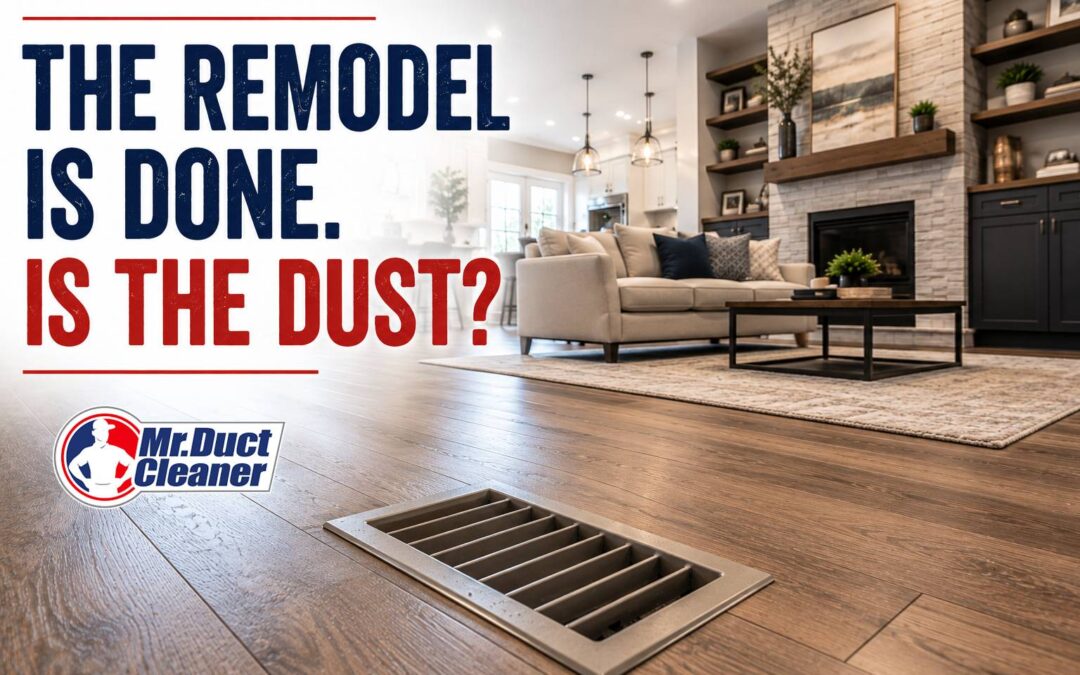
The contractors are gone. The tools have been packed up. The new flooring is down, the walls are painted, and after weeks—or maybe months—of living through a remodeling project, your home finally feels like home again.
But there may be one part of the project you haven’t finished yet:
Your HVAC system.
In Parts 1 and 2 of this series, we talked about how remodeling dust finds its way into your HVAC system and the steps you can take to help protect your system while construction is underway.
Now let’s talk about what happens after the remodeling is finished.
Just Because You Can’t See the Dust Doesn’t Mean It’s Gone
Remodeling creates an enormous amount of fine dust and contaminants.
Drywall dust, sawdust, insulation fibers, flooring debris, and other construction materials can become airborne and travel throughout the house. Even with precautions in place, some of that material can find its way into return vents, supply vents, ductwork, and HVAC components.
Once the visible construction mess has been cleaned up, it’s easy to assume the dust problem is over.
It may not be.
Your HVAC system continually moves air through your home. If construction debris has entered the system, some of those particles may continue circulating long after the remodeling crew has left.
Start With the Air Filter
One of the simplest things you can do after a remodeling project is replace your HVAC filter.
In fact, depending on the length and scope of the project, the filter may need to be changed several times during construction and again when the project is finished.
Don’t assume a filter is fine simply because it hasn’t reached its normal replacement interval. Remodeling can load a filter with dust much faster than everyday household use.
A heavily loaded filter can restrict airflow and force your HVAC system to work harder.
Look Beyond the Registers
Wiping dust from supply registers and vacuuming around return vents is a good start, but it doesn’t tell you what’s happening inside the system.
If your HVAC system operated during construction, particularly during a major remodel involving drywall, sanding, cutting, or demolition, it may be worth having the system professionally inspected.
The goal isn’t to assume that every remodeling project automatically requires duct cleaning.
The goal is to find out what actually made it into the system.
A professional inspection can help determine whether construction dust and debris have accumulated in areas that homeowners can’t easily see.
Don’t Forget the HVAC Equipment
Your ductwork isn’t the only concern.
Fine remodeling dust can potentially reach other parts of the HVAC system as air moves through it. That’s why post-remodel HVAC maintenance should be about more than simply vacuuming the vents you can see.
Remember what happened during my own remodeling project: despite taking precautions and changing filters frequently, enough remodeling dust made its way into the system to contribute to a clogged drain pan and an overflow.
That was a pretty good reminder that construction dust doesn’t always stay where you expect it to.
Make HVAC Inspection Part of Your Remodeling Checklist
We spend a lot of time thinking about the finishing touches after a remodel.
Touch up the paint.
Clean the floors.
Move the furniture back.
Remove the construction debris.
But there’s one more item worth adding to that list:
Check the HVAC system.
If you’ve recently completed a remodeling project—or you’re about to start one—Mr. Duct Cleaner can help you determine whether construction dust has made its way into your HVAC system and whether cleaning is appropriate.
Don’t wait until you’re seeing dust blowing from the vents or your HVAC system begins showing signs of trouble.
Schedule a Free Estimate with your local Mr. Duct Cleaner.
Visit mrductcleaner.com or call 844-444-DUCT.