
Absolutely! In fact, keeping your home’s air vents clean is a good habit. But there’s a difference between vacuuming the vents you can see and cleaning the ductwork hidden behind your walls, floors, and ceilings.
At Mr. Duct Cleaner, we believe homeowners should understand what they can safely maintain themselves, when a little DIY cleaning makes sense, and when it’s worth bringing in a professional.
Let’s clear the air about what your household vacuum can—and can’t—accomplish.
Yes, You Can Vacuum Your Own Air Vents
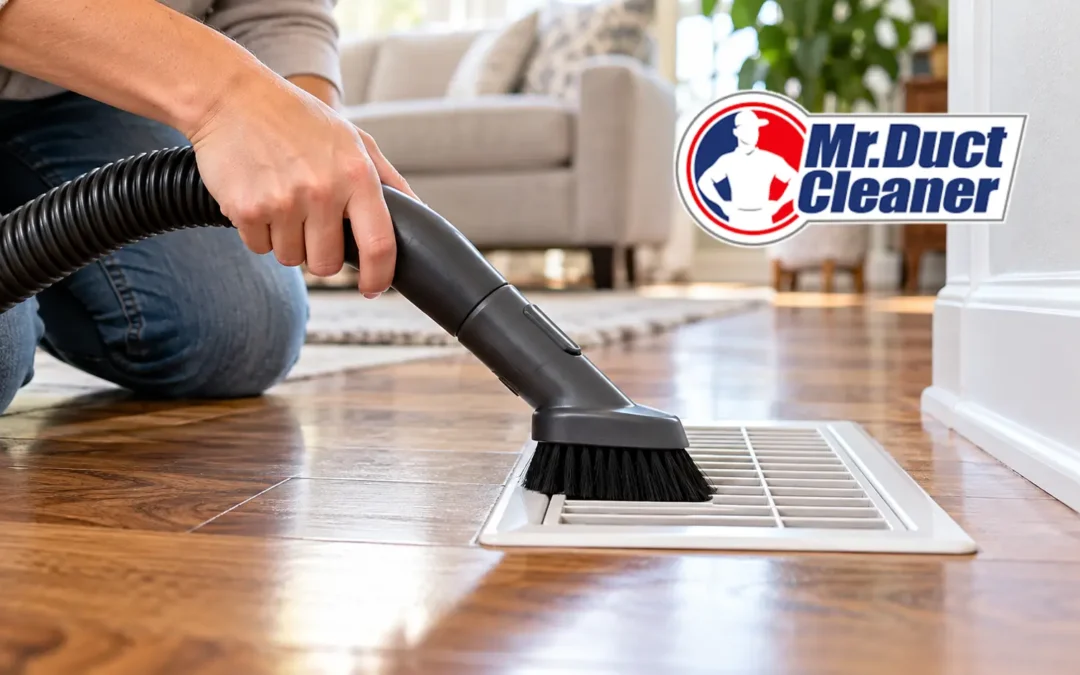
There’s nothing wrong with using your household vacuum to remove dust, pet hair, and other loose debris from accessible air vents.
In fact, it’s one of the simplest things you can do to keep your home’s heating and cooling system looking clean and well-maintained.
Over time, dust naturally accumulates on supply registers and return air grilles. You may notice it more around vents near the floor, in high-traffic areas, or in homes with pets.
A vacuum with a soft brush attachment can help remove that buildup before it becomes more noticeable.
The important thing is knowing where to stop.
What You Can Safely Clean Yourself
For most homeowners, routine vent maintenance is pretty straightforward.
Here are a few things you can generally handle without professional equipment:
-
Supply registers: Vacuum the visible louvers and surrounding edges where dust collects.
-
Return air grilles: Use a brush attachment to remove accumulated dust and pet hair.
-
Removable vent covers: When practical, remove the cover and clean it with a damp cloth. Make sure it’s completely dry before reinstalling it.
-
Accessible openings: Carefully vacuum loose debris immediately inside the opening without forcing the hose farther into the ductwork.
-
HVAC filters: Check your filter regularly and replace or clean it according to the manufacturer’s recommendations.
Before removing a vent cover or cleaning near an opening, turn off the heating and cooling system. Avoid disturbing wiring, dampers, or other components.
And here’s one important reminder: Never use your vacuum cleaner to reach deep into your ductwork.
That’s where a simple maintenance task can turn into something more complicated.
Why Your Household Vacuum Has Its Limits
Your household vacuum was designed to clean floors, furniture, and other accessible surfaces. It wasn’t designed to clean an entire residential air duct system.
Even a powerful vacuum with a long hose can only reach a relatively small portion of the ductwork.
Think about how your home’s duct system is arranged. Air travels through a network of passages that may include long horizontal runs, vertical sections, elbows, branches, and connections.
The dust you can see near a register represents only a small part of that system.
And just because the area immediately inside the vent looks clean doesn’t necessarily mean the rest of the ductwork is in the same condition.
On the other hand, a little visible dust doesn’t automatically mean your entire duct system is dirty, either.
That’s why understanding the difference between surface cleaning and professional duct cleaning matters.
Can Vacuuming Your Vents Make Things Worse?
Usually, a little careful vacuuming won’t cause any problems.
However, certain DIY cleaning methods can create unnecessary risks.
For example, pushing a vacuum hose, stiff brush, or other cleaning tool deep into a duct could damage flexible ductwork or disturb internal duct liners.
Aggressive brushing can also loosen accumulated material without actually removing it.
And using compressed air or a leaf blower to blast dust through your vents is definitely not a good idea. Without proper containment and collection equipment, you may simply redistribute dust into your home.
If you’re going to clean your vents yourself, keep it simple.
Vacuum what you can comfortably reach, avoid aggressive cleaning methods, and leave the deeper ductwork alone.
Does Vacuuming Your Vents Improve Indoor Air Quality?
This is where things get interesting.
Removing visible dust from your registers and return grilles can help keep those surfaces clean and reduce loose dust around the openings.
But it’s important not to confuse that with a complete indoor air quality solution.
The air quality inside your home is influenced by many factors, including ventilation, filtration, humidity, household activities, pets, and outdoor air entering the home.
According to the U.S. Environmental Protection Agency (EPA), routine air duct cleaning has not been shown to prevent health problems, and evidence is limited that cleaning ducts alone improves indoor air quality.
That doesn’t mean duct cleaning is never appropriate. It means homeowners should make informed decisions based on the actual condition of their system rather than assuming every dusty vent signals a serious problem.
When Should You Consider Professional Air Duct Cleaning?
While routine duct cleaning isn’t necessary for every home, there are circumstances when a professional inspection or cleaning may be worth considering.
These include:
-
Visible substantial mold-like growth: If you suspect mold inside your ductwork or HVAC components, the source needs to be properly evaluated and any moisture problem corrected.
-
Evidence of rodents or insects: Ductwork that has been infested may require pest control, cleanup, and corrective repairs.
-
Heavy debris accumulation: If significant deposits are present and particles are actually being released into living spaces, professional attention may be appropriate.
-
After certain renovations: Remodeling or construction can introduce drywall dust, sawdust, and other debris into unprotected ductwork.
-
Persistent airflow concerns: Blocked registers, dirty filters, duct damage, or other HVAC issues may require professional evaluation.
It’s worth remembering that not every airflow problem is caused by dirty ductwork. Sometimes the issue is a clogged filter, an improperly adjusted damper, or another HVAC component.
A reputable professional should help identify the problem rather than automatically recommending cleaning as the answer to everything.
What Makes Professional Duct Cleaning Different?
Professional air duct cleaning involves equipment and procedures that go well beyond what a household vacuum can accomplish.
Depending on the system and the services being performed, trained technicians may use specialized vacuum collection equipment, agitation tools, and controlled cleaning methods to remove accumulated debris from accessible portions of the duct system.
Proper procedures are designed to capture loosened material rather than allowing it to spread throughout the home.
A thorough service should also account for the construction and condition of the ductwork, including whether certain materials require special care.
The goal isn’t simply to make the vent openings look cleaner. It’s to address the parts of the system that actually need attention, using appropriate equipment and methods.
And that distinction is important.
How Often Should You Vacuum Your Air Vents?
There’s no universal schedule that works for every household.
A home with several pets, carpeting, and frequent foot traffic may need more attention than a home with fewer occupants and less dust-producing activity.
A good rule of thumb is to inspect your vents during regular household cleaning.
If you see dust collecting on the grilles, gently vacuum it away.
You don’t need to wait until there’s a thick layer of dust, and you certainly don’t need to dismantle your duct system every time you notice a little buildup.
For most homeowners, consistent light maintenance is a much better approach than occasional aggressive cleaning.
The Bottom Line: A Little DIY Cleaning Goes a Long Way
So, should you vacuum your own air vents?
Yes! Just understand what you’re cleaning.
Your household vacuum is perfectly useful for keeping accessible vent covers, registers, and return grilles free of ordinary dust and debris.
But vacuuming a vent isn’t the same as cleaning an entire duct system.
If you notice significant debris, signs of contamination, or other unusual conditions, it may be time to have your HVAC system evaluated.
At Mr. Duct Cleaner, we believe informed homeowners make better decisions about maintaining their homes. Our goal is to help you understand what’s normal, what you can handle yourself, and when professional assistance makes sense.
Because sometimes the best maintenance advice is knowing what you don’t need to do.
Have questions about your home’s air ducts?
Visit Mr. Duct Cleaner or call 844-444-DUCT to learn more about our services and find a location serving your area.