
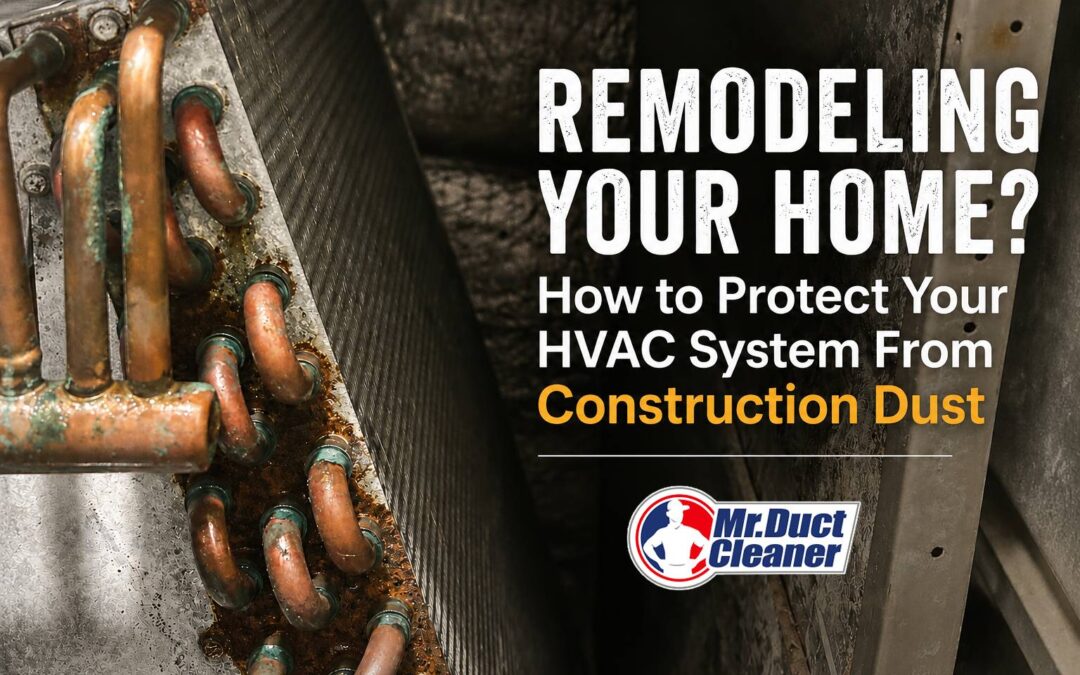
Part 2 of 3: Remodeling & Your HVAC System
In Part 1 of this series, we talked about something many homeowners don’t think about until it’s too late: remodeling dust doesn’t necessarily stay in the room being remodeled.
Drywall dust, sawdust, flooring debris, and other fine construction particles can find their way into your HVAC system. Once they’re there, your heating and cooling system may help distribute that dust throughout the rest of your home.
The good news is that there are things you can do before and during a remodeling project to reduce the amount of construction dust that gets into your HVAC system.
Your HVAC System Moves More Than Air
When your heating or air conditioning is running, the system continually pulls air from your home through return vents, moves it through the HVAC system, and sends conditioned air back through the supply ducts.
That’s exactly what it’s designed to do.
But during a remodeling project, that air can contain considerably more dust than usual.
Cutting drywall, sanding joint compound, removing flooring, cutting tile, and tearing out cabinets can release an enormous amount of fine particulate matter into the air.
If your HVAC system is operating while that dust is airborne, some of those particles can be drawn toward the return side of the system.
Your air filter is an important line of defense—but you shouldn’t expect the filter to handle everything a remodeling project can throw at it.
Talk to Your Contractor About Dust Control Before Work Begins
Dust control shouldn’t be something you start thinking about after demolition.
Before remodeling begins, ask your contractor how they plan to contain construction dust.
Depending on the project, that may include plastic barriers, temporary walls, zippered containment systems, air scrubbers or other methods of separating the work area from the occupied portions of the home.
The goal is simple:
Keep as much dust as possible contained at the source.
The less construction dust floating through your home, the less opportunity it has to reach your HVAC system.
Pay Attention to Return Air Vents
Return vents deserve particular attention during remodeling because they’re designed to pull air toward the HVAC system.
A return located near an active construction area can potentially pull airborne dust along with that air.
Ask your HVAC professional or remodeling contractor about the best way to protect nearby returns during the project. You don’t want to simply start covering vents without understanding how that could affect airflow and system operation.
This is especially important during a larger project where the HVAC system still needs to heat or cool occupied areas of the home.
Don’t Forget About the HVAC Filter
During normal conditions, you may check or replace your HVAC filter according to a regular schedule.
Remodeling isn’t normal conditions.
Construction dust can load a filter much faster than everyday household dust.
Check the filter regularly throughout the project. If it becomes visibly dirty or clogged, it may need to be replaced sooner than your normal replacement interval.
A heavily loaded filter can restrict airflow and make your HVAC system work harder.
And don’t assume that installing the highest-rated filter you can find is automatically better. Your HVAC system is designed for a particular amount of airflow, and an overly restrictive filter can create problems of its own.
When in doubt, ask an HVAC professional what type of filter is appropriate for your system.
Whenever Possible, Keep Dust-Producing Work Away From the HVAC System
Some remodeling tasks create far more airborne dust than others.
Sanding drywall is a prime example.
If possible, particularly dusty work should be performed with the work area isolated and with appropriate dust extraction or containment equipment in use.
For certain projects, contractors may also recommend temporarily shutting down the HVAC system while extremely dusty work is being performed.
The important thing is to have a plan rather than allowing the HVAC system to run normally while clouds of construction dust are hanging in the air.
Construction Dust Can Travel Farther Than You Think
One of the surprises homeowners often encounter during remodeling is discovering dust in rooms nowhere near the construction.
You may be remodeling the kitchen and find a fine layer of dust in a bedroom at the opposite end of the house.
That’s because extremely fine particles don’t always stay where they’re created.
People walking through the house can carry dust. Air movement can carry it. Opening doors can move it. And your home’s heating and cooling system can potentially contribute to moving airborne particles from one area to another.
That’s why protecting your HVAC system should be part of the remodeling plan—not an afterthought.
What About the Ductwork?
Even with good dust-control practices, some construction debris may still find its way into the HVAC system.
How much depends on the project, the layout of the home, how the HVAC system was operated during construction and how effectively the work area was contained.
That’s also why simply looking at the dust you can see isn’t necessarily enough.
After a significant remodeling project, it’s worth considering what may have accumulated in the portions of your HVAC system that you can’t see.
And that brings us to the final part of this series.
Your Remodel May Be Finished. Your HVAC System May Not Be.
New floors are down. The cabinets are installed. The countertops look great. The contractor has packed up and the house finally looks finished.
But what happened inside the HVAC system while all that work was taking place?
In Part 3, we’ll look at what homeowners should check after remodeling is complete—and why post-construction HVAC system cleaning may deserve a place on your final remodeling checklist.
At Mr. Duct Cleaner, we don’t believe in cleaning only one piece of the system and calling the job finished. Our approach focuses on the complete HVAC system, including the areas where dust and debris can accumulate beyond what you see at the registers.
If you’ve recently completed a remodeling project—or you’re preparing to start one—request a Free Estimate at mrductcleaner.com or call 844-444-DUCT.