


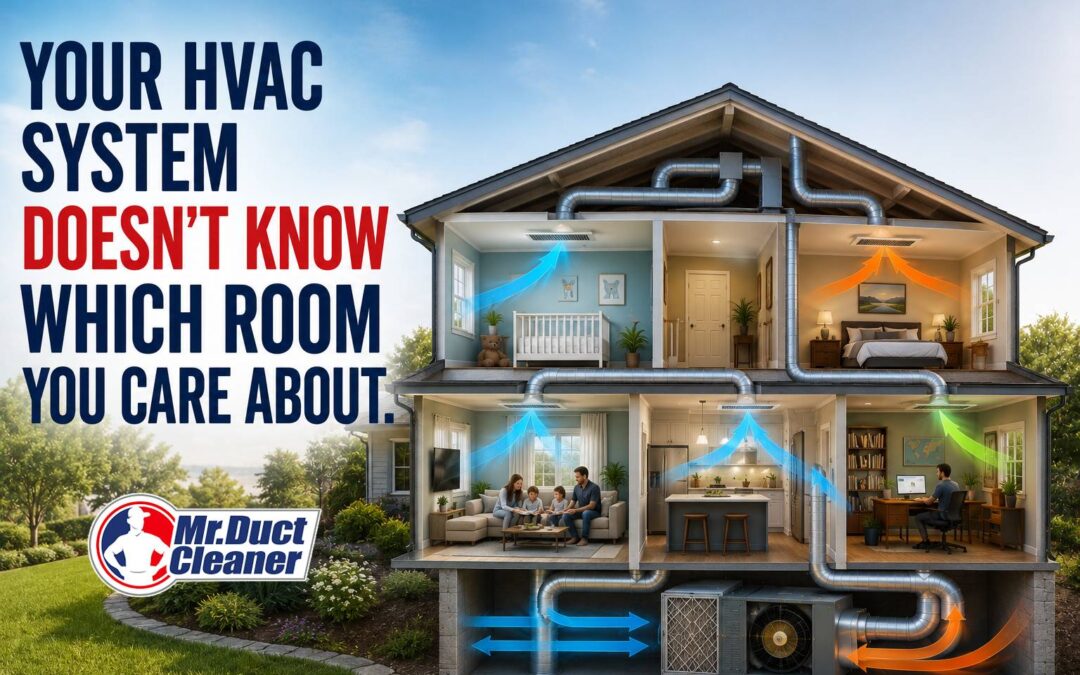
When homeowners think about indoor air quality, they usually think about a specific room.
Maybe it’s the baby’s nursery.
Maybe it’s the bedroom where they sleep.
Maybe it’s the family room where everyone gathers in the evening.
Or perhaps it’s a home office where they spend eight hours a day.
It makes perfect sense. We naturally focus on the places where we spend the most time. But your HVAC system sees your home very differently.
It doesn’t know which room matters most to you.
It simply moves air.
Every time your heating or cooling system turns on, it pulls air from throughout your home, conditions it, and sends it right back through your ductwork. Your HVAC system treats your entire house as one connected environment. That’s why indoor air quality isn’t just about one room—it’s about the entire system that serves your home.
Your Home Shares the Same Air
Think about how your HVAC system works.
Air is pulled through return vents located throughout your home. That air travels through your ductwork, passes through your air filter, moves across the blower assembly and evaporator coil, and is then distributed back into every room through the supply vents.
It’s a continuous cycle that repeats day after day.
That means the air in your bedroom today may have passed through your living room, kitchen, hallway, or home office just minutes before. The system doesn’t separate one room from another. It continuously mixes and circulates the air throughout your home.
This is why something that starts in one room rarely stays there.
Dust Doesn’t Stay Where It Starts
Every home collects airborne particles.
Dust from everyday living.
Pet hair and dander.
Pollen that enters through open doors and windows.
Cooking particles.
Smoke.
Skin cells.
Fibers from carpeting, furniture, and clothing.
As your HVAC system operates, many of these particles are drawn into the return ducts and carried through the system. While a quality air filter captures a significant amount of airborne debris, no filter captures everything. Over time, some particles can accumulate on components inside the HVAC system, including the blower assembly, evaporator coil, and ductwork.
The longer buildup is allowed to accumulate, the harder your system has to work to move air efficiently.
A Clean Vent Doesn’t Mean a Clean HVAC System
Many homeowners assume that if the supply registers in their rooms look clean, the entire HVAC system must be clean as well.
Unfortunately, that’s not always the case.
The parts of your HVAC system that do the most work are hidden from view.
Behind the walls, above the ceiling, inside the air handler, and within the ductwork, your system operates every day without most homeowners ever seeing it.
That’s where dust and debris can collect over time.
Looking at a clean supply register is a little like judging the cleanliness of a car engine by looking at the outside of the hood. The important components are what’s underneath.
Cleaning One Part Doesn’t Clean the Whole System
Imagine washing only one tire on your vehicle and expecting the entire vehicle to look clean.
Or cleaning only one room in your home before inviting guests over.
Most people would never do that because they understand everything works together.
The same principle applies to your HVAC system.
Cleaning only one portion of the air pathway doesn’t address the rest of the system where dust and debris may also accumulate. Your HVAC system functions as a complete, interconnected system, and each component plays an important role in moving conditioned air throughout your home.
That’s one reason why professional HVAC system cleaning focuses on more than just the visible vents.
Think of It Like a River
Imagine a river flowing through several towns.
If one section of the river becomes polluted, that water continues flowing downstream. Cleaning only a short stretch doesn’t stop the water from carrying contaminants through the rest of the river.
Air behaves in a similar way inside your HVAC system.
Every time the blower turns on, air travels through the same pathway over and over again.
It doesn’t stop at the doorway to your favorite room.
It continues throughout the home.
That’s why improving indoor air quality starts with understanding how the entire system works—not just one room.
Why Whole-System Cleaning Matters
Your HVAC system is one of the hardest-working systems in your home.
During the heating and cooling seasons, it may operate for hours every day, circulating thousands of cubic feet of air throughout the house.
When components such as the blower assembly, evaporator coil, and ductwork become coated with accumulated dust and debris, airflow can be affected and overall system cleanliness may decline.
A professional whole-system HVAC cleaning is designed to address the complete air pathway, helping remove accumulated debris from the components that move air throughout your home.
Rather than focusing on only one visible area, the goal is to clean the system that serves every room.
The Air You Breathe Is a Whole-House Experience
It’s easy to think of indoor air quality room by room.
But your HVAC system doesn’t think that way.
Whether you’re relaxing in the family room, sleeping in your bedroom, working from your home office, or watching your children play in the living room, your heating and cooling system is continuously moving air throughout the entire house.
Every room is connected.
Every cycle of your HVAC system brings that air together again.
If your goal is cleaner indoor air, it’s important to think beyond individual rooms and consider the entire system that serves your home.
Because your HVAC system doesn’t know which room you care about.
It cares for them all.
If you’d like to learn more about professional whole-system HVAC cleaning and how it may benefit your home’s indoor air quality, the team at Mr. Duct Cleaner is here to answer your questions. Visit mrductcleaner.com or call 844-444-DUCT a Free Estimate.